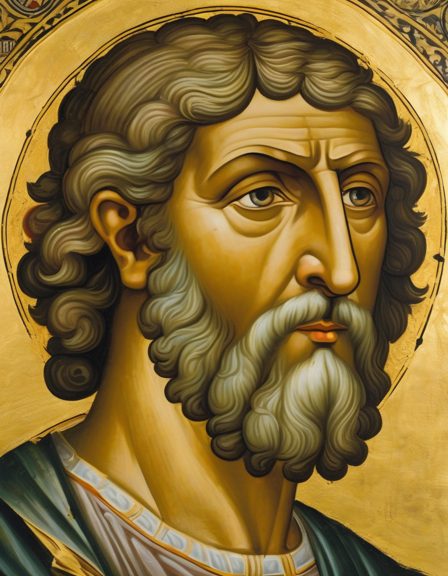
Plato
Mentions
Plato appears in 6 chapters:
Chapter 172
- Gaiad 172.58 Hemlock. His trial and execution, described in Plato's Apology,
- Gaiad 172.62 His students: Plato and Xenophon. Plato (four-twenty-seven to
- Gaiad 172.64 Relationship between the historical Socrates and Plato's literary
- Gaiad 172.64 Socrates is debated; in the earlier dialogues Plato probably
- Gaiad 172.65 Plato's philosophical system—the theory of the forms, the tripartite
- Gaiad 172.66 Philosophy is "a series of footnotes to Plato"—an overstatement,
- Gaiad 172.66 But capturing something important. And Plato's student Aristotle
- Gaiad 172.67 (Three-eighty-four to three-twenty-two BCE) would take Plato's
- Gaiad 172.80 And Socrates. Plato and the Academy. Aristotle in the wings.
Chapter 173
- Gaiad 173.3 Their Athenian predecessors: Plato and Aristotle. And it would
- Gaiad 173.4 Begin with Plato
- Gaiad 173.6 Plato begins to develop his own philosophical positions. Republic,
- Gaiad 173.9 In Plato's corpus. Most people, Plato writes, are like prisoners
- Gaiad 173.11 Plato's teacher Socrates was executed for attempting just such
- Gaiad 173.12 Plato's Republic argues that ideal political societies would
- Gaiad 173.12 Good, just, and beautiful. Democracy, Plato argued, produces only
- Gaiad 173.14 Philosophy, and it is worth noting that Plato wrote it after
- Gaiad 173.15 Plato's political vision should be read in light of that trauma.
- Gaiad 173.16 Statesman, Philebus, Laws, Timaeus—show Plato revising
- Gaiad 173.19 Plato's work is vast, varied, and endlessly generative. It would
- Gaiad 173.22 Macedonian royal family. He studied with Plato for twenty years,
- Gaiad 173.22 Until Plato's death. He was passed over for leadership of the
- Gaiad 173.30 Along with Plato's and Augustine's, one of the three or four
- Gaiad 173.40 And alongside Plato and Aristotle, the fourth century produced
- Gaiad 173.61 Maturation—Plato, Aristotle, the philosophical schools, the
- Gaiad 173.68 Every student who stood at the feet of Plato or Aristotle was
- Gaiad 173.73 Greece, part three. Plato and the Academy. Aristotle and the
Chapter 197
- Gaiad 197.3 The works of Aristotle, Plato, Galen,
Chapter 220
- Gaiad 220.4 Marsilio Ficino was translating Plato into Latin.
Chapter 221
- Gaiad 221.29 Where Plato and Aristotle's commentary
- Gaiad 221.31 The seeds of Plato planted in Florence's soil,
Chapter 223
- Gaiad 223.9 Of time: the manuscript of Plato,
Genealogy
Parents
- Father: Lycaon